
VaadinBench is Vaadin's benchmark for AI coding agents: it gives agents real Vaadin tasks and scores each attempt with deterministic tests similar to e.g. Artificial Analysis Coding Agent benchmark. This post uses it to compare two frameworks instead of two agents. The goal was to see whether the choice of framework changes the result. The same agents and models built one feature of a Petclinic sample app in both Vaadin and Angular, 160 trials in total.
After I had completed the VaadinBench October test run, which consisted of 1440 trials where different agents ran the benchmark tasks with different models and configurations, I decided to try to replicate what Simon Martinelli had earlier mentioned on the Vaadin forum. He stated that with his AIUP Petclinic project he was able to get his use case UC-002 built 3 times faster with Vaadin than with Angular using Claude Code with Opus 5 (1min 30 sec vs 4min 45sec). That sounded very intriguing so I decided to test what kind of results I could get by copying what he was doing but creating a repeatable benchmark task and adding it to VaadinBench itself. For more information on VaadinBench itself you can check the earlier blog post by Sami Ekblad from September.
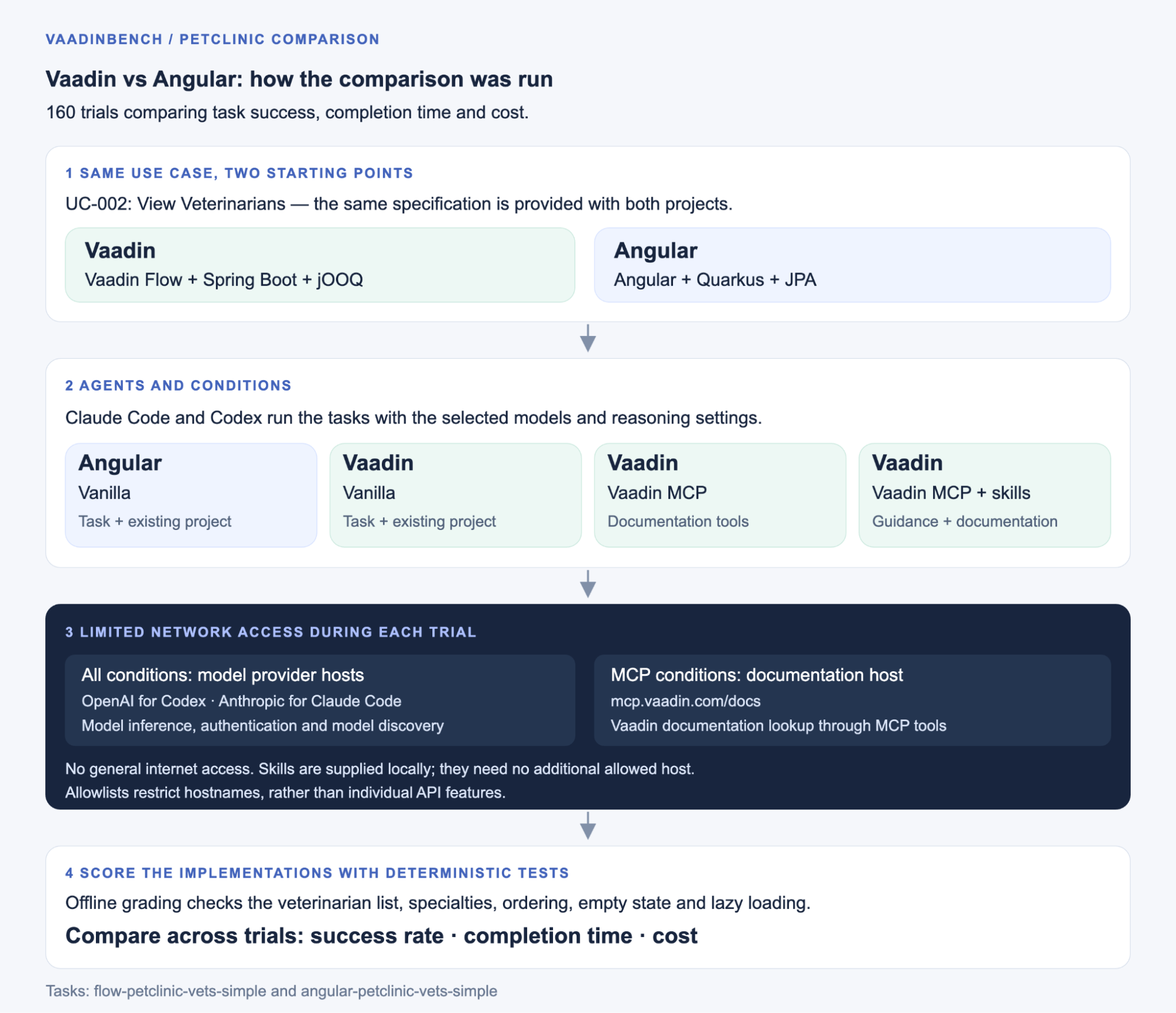
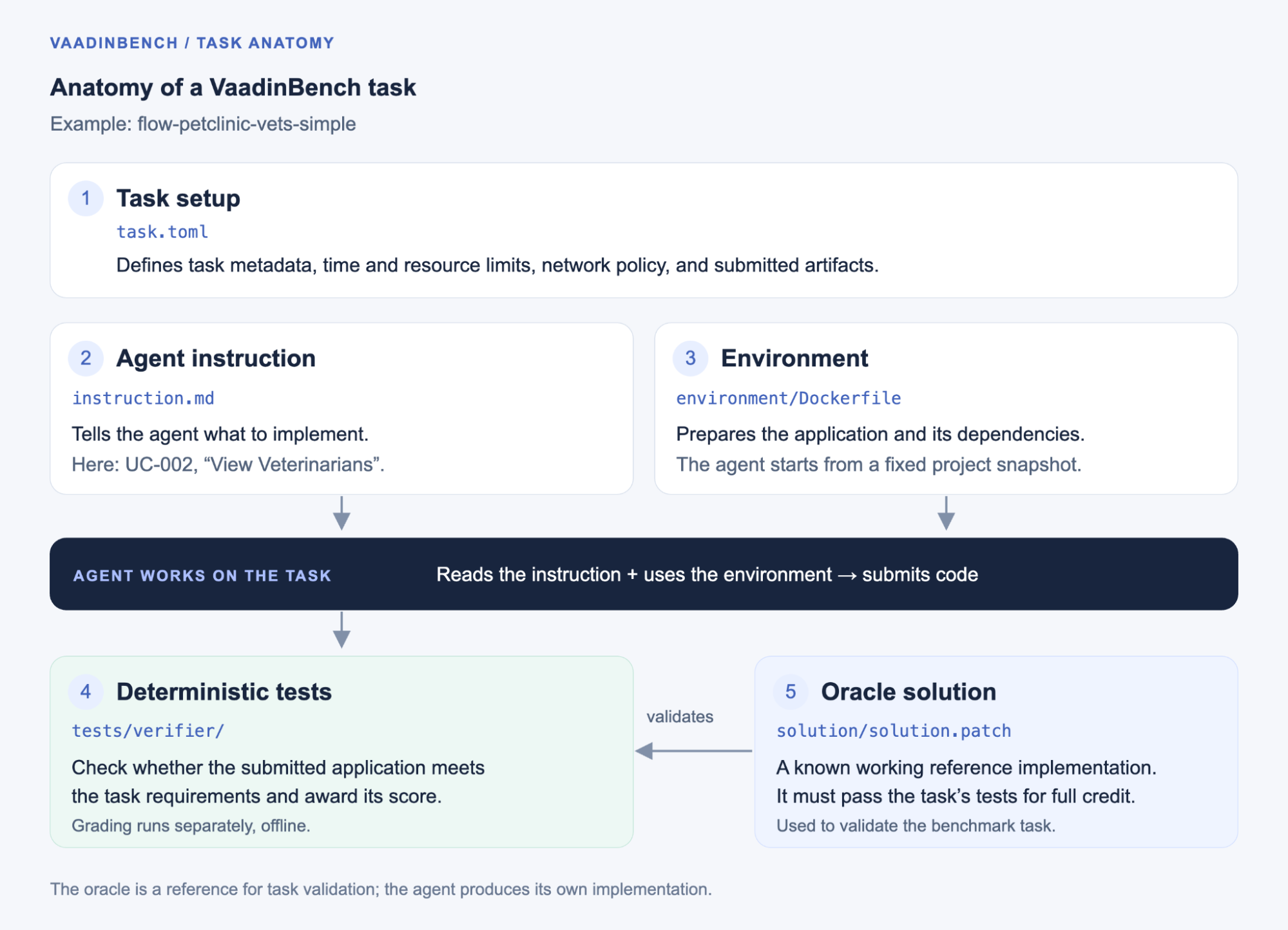
First I forked my own version of Simon's repo where I prepared the Angular version as the initial setup for the task with the help of Claude Code and Opus similar to how Simon explained he had done it. Next I created new tasks in VaadinBench, one where Angular was being used and one where Vaadin was the go to solution. The tasks are exactly the same as in every other VaadinBench task comprising:
- The task setup
- The task instruction for the agent on what it needs to do
- The environment the task is being run in.
- The deterministic tests that evaluate whether the task was completed successfully or not.
- An oracle solution which always gets the full score in solving the task.
Once the tasks were ready I gave the following prompt to Codex with Sol 6.1 which acted as the orchestrator agent spinning up the different trials on Docker containers where the agents then carried out the task instruction. I asked it to run a full suite of tasks with multiple different models in order to see how well each one fared with Angular, Vaadin, and with Vaadin skills and MCP:
Run the petclinic-vets-simple with angular and Vaadin using Haiku 5.5 medium & xhigh, Sonnet 5, Opus 5.5. Luna medium & xhigh, Sol 6.1, and Astra.
With Angular only use vanilla. With Vaadin use vanilla and vaadin-skills-mcp configurations. Run maximum of 2 Claude Codes and 3 Codexes. 5 trials each.
The agents in the benchmark only have access to a limited number of hostnames depending on their configuration. We're mostly interested in testing the capabilities of the models after all as opposed to their ability to find the correct solution online e.g. from GitHub. By default in VaadinBench the agent has an empty array of allowed hosts i.e. no access anywhere outside. Based on whichever agent or condition is being used, that allowed_hosts array is then modified so that the model can actually work properly in the following fashion:
| Agent / condition | URL or host allowed | Intended use |
|---|---|---|
| Codex (all conditions) | https://api.openai.com |
Model inference when using an OpenAI API key. |
| Codex (all conditions) | https://chatgpt.com |
Model inference through a ChatGPT subscription; Codex also uses this host for model discovery. |
| Codex (all conditions) | https://auth.openai.com |
Refreshing authentication tokens for ChatGPT subscription access. |
| Claude Code (all conditions) | https://api.anthropic.com |
Model inference through Anthropic. |
| OpenCode (built-in provider) | https://opencode.ai |
Accessing the selected model through OpenCode's provider. |
| OpenCode (custom OpenAI-compatible endpoint) | User-configured endpoint | Model inference through the selected server. |
| Conditions that include Vaadin MCP | https://mcp.vaadin.com/docs or /old/docs |
Looking up Vaadin documentation through the MCP tools. |
Any agent on flow-new-project |
Public internet access | Discovering how to create a Vaadin project and obtaining the project skeleton. |
The exact place where those are added can be found in vaadin-bench.py which is what is used to start executing the benchmark:
From that a total of 160 trials were completed and scored. I generated an HTML page with Codex using Sol 6.1. In short I found that with Vaadin MCP server + skills the results were 20 % faster with Codex and 30 % faster with Claude Code than Angular. Based on the same deterministic tests the end result also was better i.e. Vaadin passed them at a higher rate than Angular.
Vaadin was also roughly 70 % cheaper with Codex and 37 - 52 % cheaper with Claude Code than Angular. The result is fully reproducible as I ran it many times with many different configurations and the results are pretty much the same. Statistically with those tasks, in those environments, with the configurations provided Vaadin is cheaper and faster to build apps with.
The full results for this Vaadin vs Angular comparison can be found on the GitHub Pages for VaadinBench results.
I'll go through the whole VaadinBench story, including this comparison, in a live webinar on Wednesday, December 2, at 15:00 CET. Register for "How well do coding agents write Vaadin?"