Tag: Framework

Vaadin Upload asks the developer to provide an OutputStream where the framework can stream the file content. Vaadin StreamResource (~ download) asks the developer to provide an InputStream the framework can read and stream to a user. Intuitive? Not really, unless you have accustomed to this inversion during your Vaadin career.


Testing the UI without a browser
Martin Fowler has introduced a metaphor Test Pyramid, to suggest that you should only write a fraction of end-to-end tests compared to small unit tests. It is not because end-to-end tests, like the ones using Vaadin TestBench or Selenium, are worse. They are actually better as they test all parts ...
Microservices: Fault Tolerance
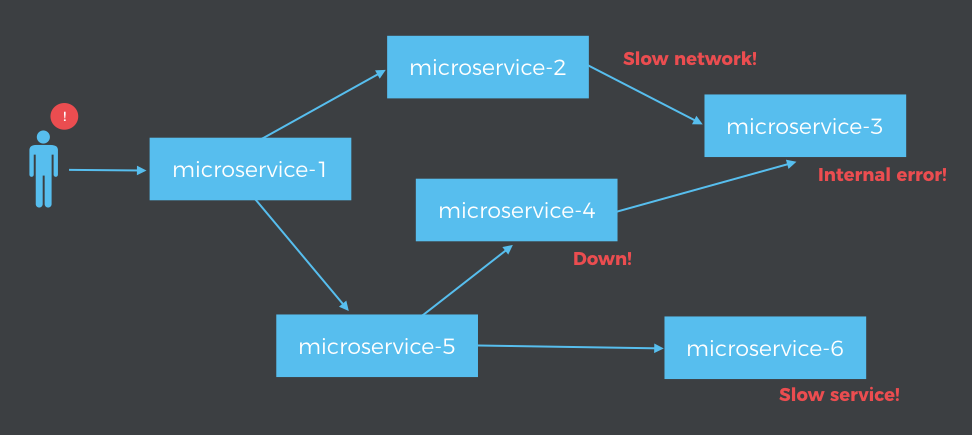
In the previous article of this series, we developed two functional microservices: a REST web service, and a web UI for it. In this article, we’ll add fault tolerance capabilities, by making the web UI resilient to failures in the REST web service. Why do we need this? Microservices depend on other ...

Microservices: Externalized Configuration
In the previous article of this series, we implemented a Discovery Server to allow microservices to consume other microservices without knowing their exact location. The code is available on GitHub, and you can find the instructions to run the demo application in the first article of this series. ...
Desktop UIs will stay alive thanks to Web Technologies
What is wrong with Java Desktop technologies? To understand what’s wrong with Java Desktop apps, let's take a look at the new features of JavaFX, the most leading UI framework for desktop applications. It becomes obvious that it is trending towards the web approaches, borrowing more and more ...
Vaadin's frontend direction
There has been some discussion about what the recently announced Vaadin 10 platform means in the context of GWT. I'll summarise some background about the direction we're taking here. I want to bring up two central themes: component models and freedom of choice. Component models UI development ...

Vaadin Framework 8 roadmap 2017 and beyond
What happened during 2017? Vaadin Framework 8.0 was released on February 2017. It brought more than 21 Improvements to Vaadin Framework. One of the major features was full Java 8 support. Java 8 allowed us to dramatically improve the Data API. We released Vaadin Framework 8.1 in July. It took a bit ...

Charts with Vaadin
A great web application needs awesome graphs to visualize data in a human-readable form, so let’s have a look at how to add some to yours. Let’s first consider the different options we have for creating charts; Vaadin Pro and Prime come with Vaadin Charts, Vaadin Directory has several add-ons for ...
Community Spotlight - July 2017
A key element in any successful open-source project is its community. In the case of Vaadin, the community collaborates mostly by asking and answering questions in forums, reporting issues, suggesting improvements, contributing with patches to the core products or with add-ons published at ...
How to bind your form to your domain model – the Vaadin 8 style
Lots of web applications require the user to input some data in order to manipulate it later. This article shows how Vaadin makes this task easy to implement. We will be using Vaadin 8 and Java 8 in this article. The source code can be found at the following GitHub page: ...