Tag: Spring

Guest blog by XDEV – a German software company and active member of the Vaadin community. In this post, they introduce Extras for Spring Security (XDEV SSE)—a set of modules that simplify and enhance security in Spring applications.


How to integrate Vaadin into your Spring project: A step-by-step guide
Do you have a Spring project you'd like to enhance with a user interface? Or perhaps you're considering an alternative to your existing frontend solution? With Vaadin, you can seamlessly integrate UI and backend development in Java and evolve your project into a full-stack application. In this ...


Hot-deploy your code – keep focus on your work
Time is money. Something that I still don’t get is that many Java developers spend a lot of it (time and money) while waiting to see their latest code changes in action. JVM is known for its great peak performance when serving large numbers of users, but our tooling isn’t by default that well ...


Community Answer: Understanding inversion of control and dependency injection
There are two key concepts that you must understand when you start with Spring or JakartaEE/CDI–inversion of control and dependency injection. In brief, inversion of control means letting a framework take control of the execution flow of your program to do things like create instances of your ...

Microservices: Health monitoring
In previous articles of this series, we discussed high availability and fault tolerance capabilities to make services resilient to failures in external services. In this article, we’ll add “health endpoints” and implement a dashboard to visually monitor service status. Why do we need this? ...
Microservices: High availability
One of the objectives of microservices is to allow independent deployment and scaling of applications. We already learned how to create a UI composition in the previous article of this series. In this article, we’ll learn how to replicate stateful web applications to help supporting high ...
Microservices: UI composition
In this article, Microservices: UI composition, we'll learn how to implement two separate independent Vaadin applications rendered in a single web page. We have covered service discovery, externalized configuration, stateless services, and fault tolerance. In this article, we’ll learn how to ...
Microservices: Fault Tolerance
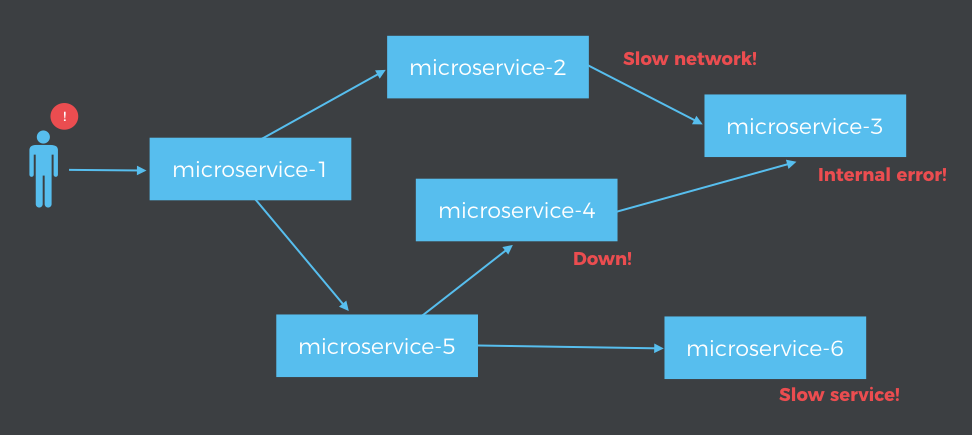
In the previous article of this series, we developed two functional microservices: a REST web service, and a web UI for it. In this article, we’ll add fault tolerance capabilities, by making the web UI resilient to failures in the REST web service. Why do we need this? Microservices depend on other ...
Microservices: Consuming stateless services from Vaadin UIs
In the previous articles of this series, we focused on developing orchestration services to enable microservices. We implemented a Discovery Server to let applications consume services without knowing their exact location, and a Configuration Server to allow microservices to run in multiple ...
Microservices: Externalized Configuration
In the previous article of this series, we implemented a Discovery Server to allow microservices to consume other microservices without knowing their exact location. The code is available on GitHub, and you can find the instructions to run the demo application in the first article of this series. ...